X-ray Accreting Pulsar Engine
Houston, we have plasma.
What it does
Have you ever wondered what it looks like when a dead star's heart gets angry? Welcome to the cosmic violence simulator nobody knew they needed where you get first row seats to the most destructive tantrum in the universe!
What are pulsars? Pulsars are highly magnetized, rapidly rotating neutron stars, and are categorized by rotation-powered, accretion-powered, or magnetar types based on how they generate energy. They are also classified by their spin speed, which separates younger, slower ordinary pulsars from highly accelerated, "recycled" millisecond pulsars. Depending on their energy output, these cosmic objects primarily broadcast their beams across radio, X-ray, or gamma-ray wavelengths.
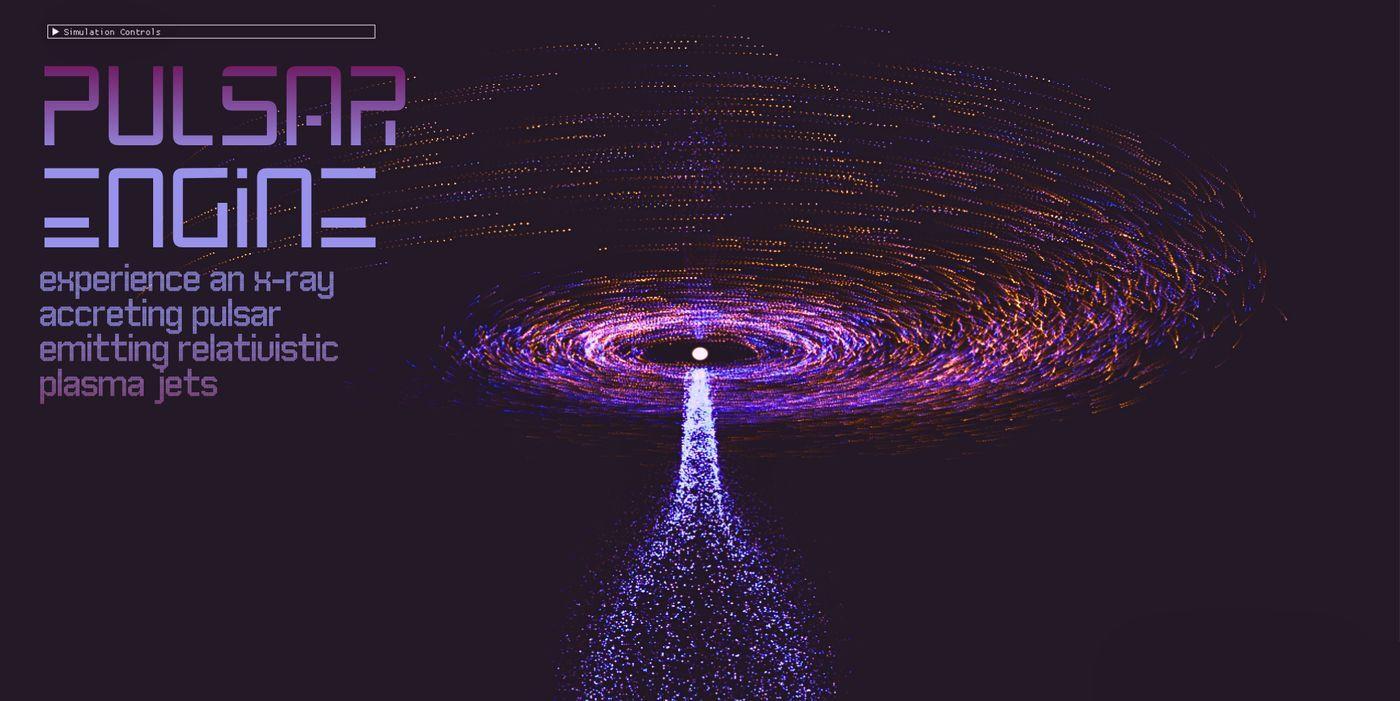
- The simulation - This simulation models an X-ray binary accretion system (a neutron star or compact object pulling material in from a companion star through an accretion disk) The material spirals inward, gets heated to insane temperatures, and gets ejected as relativistic jets shooting perpendicular to the disk. The jets get squeezed and collimated by magnetic fields, creating those narrow beams you see. The plasma jets (the two beams you see): relativistic plasma (electrons and positrons) that produce synchrotron radiation in magnetic fields – X-rays, radio, infrared, optical. We call them X-ray binaries because X-rays are the brightest part, the jets are plasma but the X-rays are just their emission. The accretion disk (the orange spiral): material from a companion star spiraling into the neutron star at the center. As it falls in, friction heats it up and gravity tears it apart, which powers the entire system and launches the jets.
- The reason behind the sim - I built this to visualize that specific scenario because it's one of the most violent and energetic processes in space, and frankly, it's beautiful when you can actually see it happen. The main thing I wanted to showcase is that accretion-ejection balance, how material falls in, releases gravitational energy, and the system throws half of it back out as jets. That's what powers X-ray binaries and other extreme systems. Some real life examples of an X-ray accreting pulsar would be the Her X-1, Cen X-3, Vela X-1, etc.
The Science behind the sim - Actually accurate - Keplerian orbital mechanics - material closer to the center moves faster Logarithmic spiral structure in the disk - real density wave patterns Magnetic pinch instability - keeps jets collimated instead of exploding sideways Relativistic beaming - particles moving toward you appear brighter (Lorentz effect) Particle aging and recycling - continuous system dynamics Proper 3D-to-2D projection with perspective and distance Additive light blending - realistic photon accumulation and glow Force balance between gravity pulling inward and jets pushing outward - Simplified for Performance - Magnetic field is a sine-wave pattern, not a full 3D MHD simulation Temperature is visual only - real disks reach 10 million Kelvin No pair production (real jets are more energetic at that scale) Softening parameter prevents math errors near center Uniform particle mass (reality has electrons and ions) Uniform viscosity (real disks have turbulent variation) Jets are too smooth (real systems like Her X-1 have chaotic jets)
How real is this? This simulation captures the core physics of how X-ray binaries actually work. The accretion-ejection mechanism is real, the orbital mechanics are legit, and the magnetic confinement is based on actual phenomena we observe. But it's cleaner than reality. Real systems like Her X-1 and Cen X-3 are messier, and chaotic with turbulent jets driven by brutal surface magnetic fields. This is a more simplified but scientifically grounded visualization of what's happening.
- Simulation controls - Jet Velocity (0.1–5.0): How fast particles escape outward Magnetic Pinch (0.1–5.0): How tightly fields squeeze the jets Relativistic Beaming (0.0–3.0): Doppler brightening effect Time Speed (0.1–5.0): Simulation speed Active Particles (5K–15K): Particle count (more = smoother but slower) Friction/Damping (0.0–1.0): Plasma resistance Color Mode (0–2): Temperature, Age, or Velocity coloring Space bar — Pause and resume the simulation R key — Reset everything back to default You can adjust these parameters using the sliders as per your preference!
Thank you for reading, hoping you like it :)