Wesker: A Real-Time Sagittarius A*
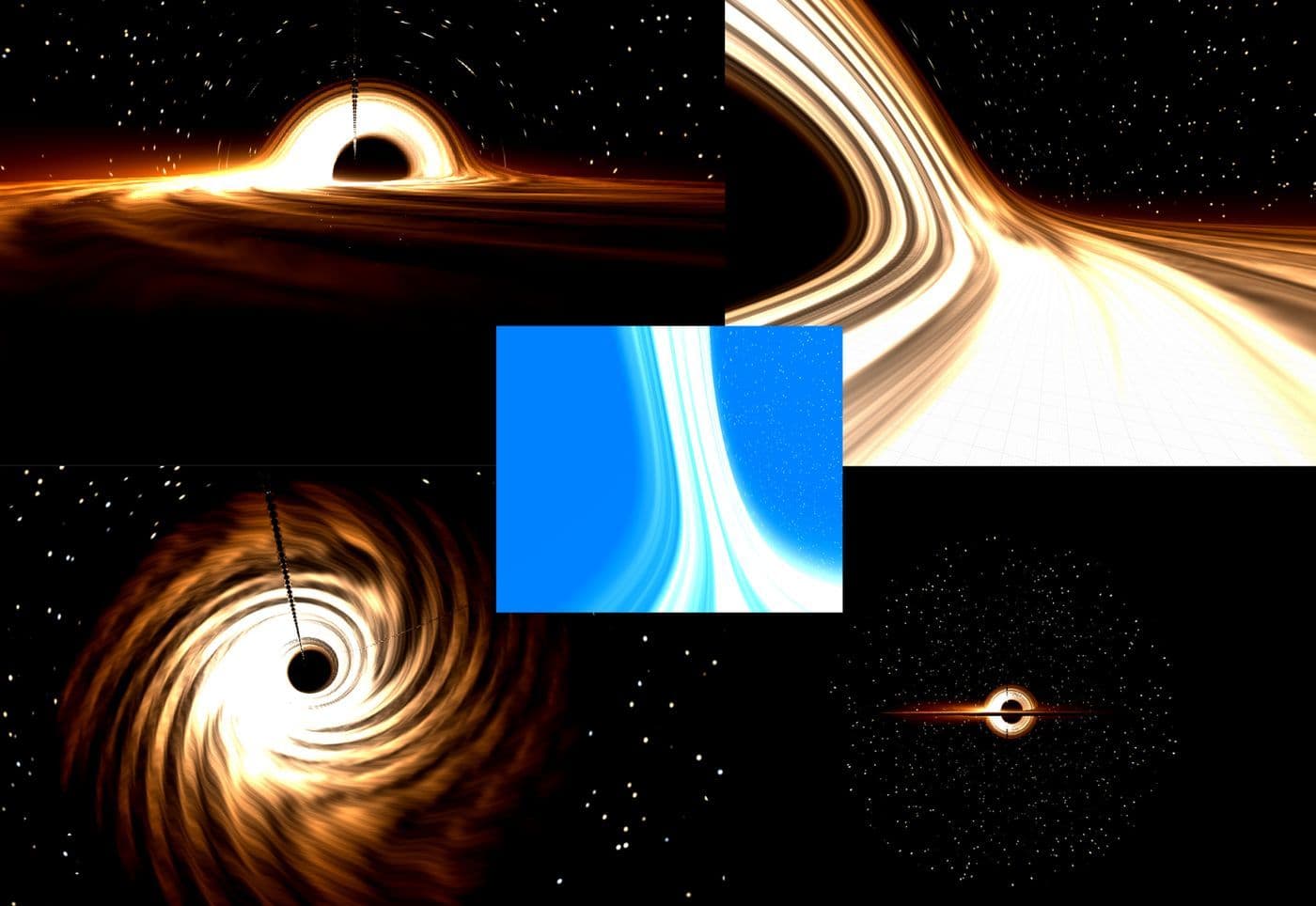
A real-time simulation of Sagittarius A*, our galaxy's own black hole, ray-traced live inside Unreal Engine 5.8 using the actual Kerr geodesic equations — not a script, an interactive simulation you can fly through.
What it does
Wesker is a real-time simulation of Sagittarius A*, the supermassive black hole at the center of our own galaxy . More specifically, the one the Event Horizon Telescope actually photographed in May 2022, about 27,000 light-years from Earth. It runs entirely inside Unreal Engine 5.8.
Every frame, a custom HLSL shader fires a ray backwards from the camera for roughly a million pixels, then bends each one by numerically integrating the real Kerr geodesic equations (RK4 integration, up to 300 steps per ray) as the spinning black hole solution, since real black holes spin. Nothing in the resulting image is hand-drawn: the photon ring, the warped image of the disk's far side arcing over the shadow, and the brightness asymmetry across the disk all emerge directly from the ray-bending math.
Every frame also computes real physics live: the event horizon and innermost stable orbit as actual functions of spin, a combined gravitational-redshift-and-Doppler "g factor" that sets both brightness (∝ g⁴) and color shift per ray, and a blackbody temperature-to-color mapping for the disk. A HUD reports distance, redshift, and time dilation as you fly, recalculated continuously.
Unlike Interstellar's Gargantua, which used a fictional near-maximal spin chosen for the plot, Sgr A*'s real spin has never been precisely measured — so spin here is treated honestly, as a tunable illustration rather than a settled number.
Approximations are disclosed, not hidden: the disk is idealized as thin and stable, where the real EHT image is patchy and changes shape within minutes (a full orbit this close takes only ~30 minutes); turbulence is procedural noise, not fluid dynamics; background stars aren't redshifted.
Mass, spin, size, and dust are live parameters so drag spin up and watch the horizon's shadow visibly distort into the D-shape frame dragging predicts.
Finally, the shader renders a mathematically exaggerated violet quantum fringe at the event horizon boundary to represent Hawking radiation while acknowledging the quantum emissions that, though physically far too cold to see (~1.5e-14 K), connect general relativity to quantum thermodynamics.