Ultimate Spectral Chaos: N-Body Problem, Black Hole Merger
Disrupt a two body system with YOUR black hole(s) and CONTROL the forces ripping apart stars
What it does
Ultimate Spectral Chaos is an interactive real-time 3D gravitational field simulator built with Python and Taichi. It combines an N-body gravity solver with GPU-accelerated particle rendering to visualize how gravitational fields evolve through orbital motion. Rather than using scripted animations, every orbit, resonance, capture event, and chaotic interaction emerges naturally from the underlying physics.
YOU can interact with it by creating your OWN black holes. Keep an eye on the black hole counter in the bottom left as there is no upper limit till your laptop crashes.
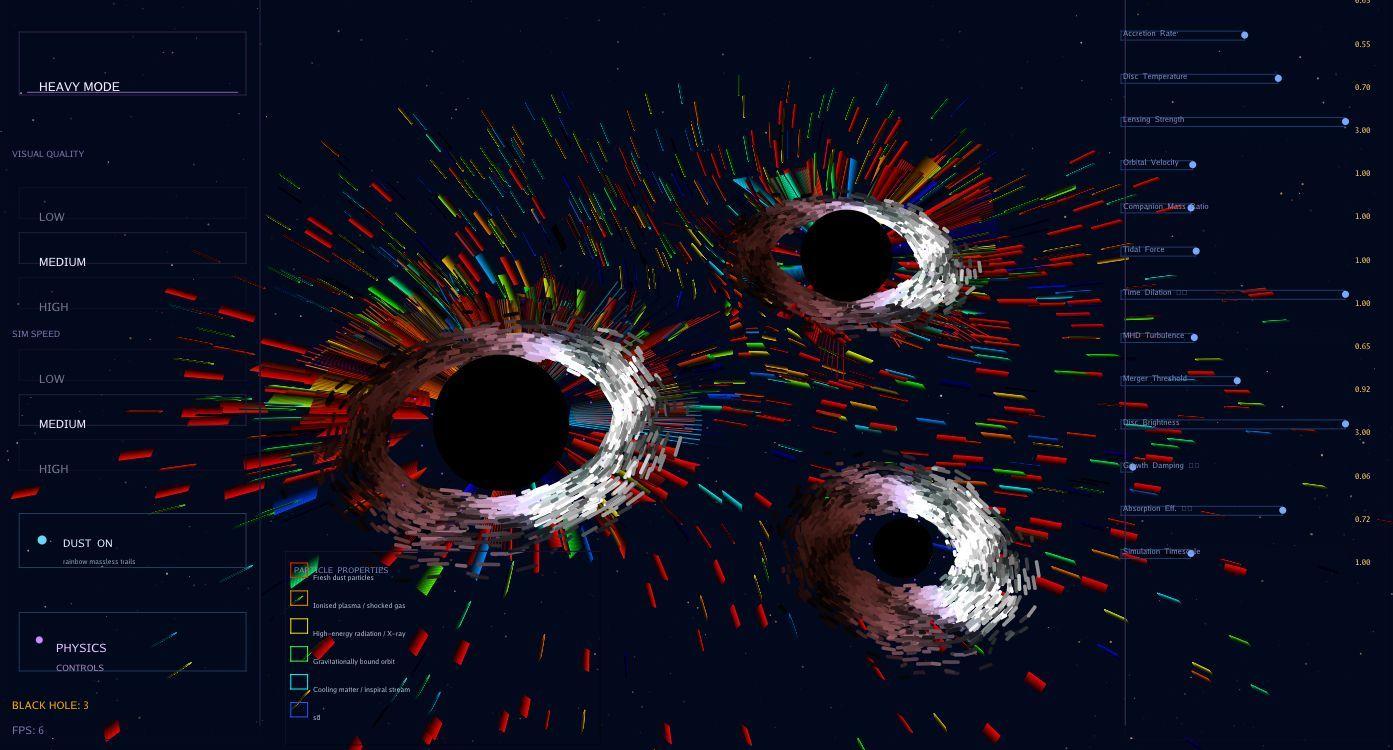
The simulation begins with a stable binary black hole system. New black holes can be added to reshape the gravitational field, while 1,000 massless tracer particles continuously reveal orbital paths, gravitational streams, resonances, and chaotic regions. Two visualization modes present the same physics in different ways: Light Mode emphasizes clarity to see the physics at work more clearly through the motion of the particles and a simpler black hole model, while Heavy Mode renders visually cohesive black holes with event horizons, rotating accretion disks, gravitational lensing and a central view of the spaghettification process.
Featuring… > Real-time 3D N-body gravity simulation > Stable binary black hole system >at the start > Long-term orbital rotational mechanics > 1,000 GPU-accelerated tracer particles > Emergent orbital paths, resonances, and chaotic dynamics > Light and Heavy rendering modes (preventing overheating) > Accretion disks and approximate gravitational lensing > Interactive 3D orbit camera > Adjustable simulation speed and visual quality > Detailed physics control panel > Optimized GPU implementation using Taichi
Created using Python, Taichi, Numpy!!
Ultimate Spectral Chaos was developed as a fun scientific visual to demonstrate the orbital mechanics of combining black holes and the forces of attraction of the particles around it. I hope you liked the simulation :)
*If Heavy Mode is too laggy, switch to Light Mode, however, the visual quality will be heavily compromised while the physics of the particles will still be rendered accurately.