The Last Orbit
Bend starlight. Shred matter. Dilate time. All in one window.
What it does
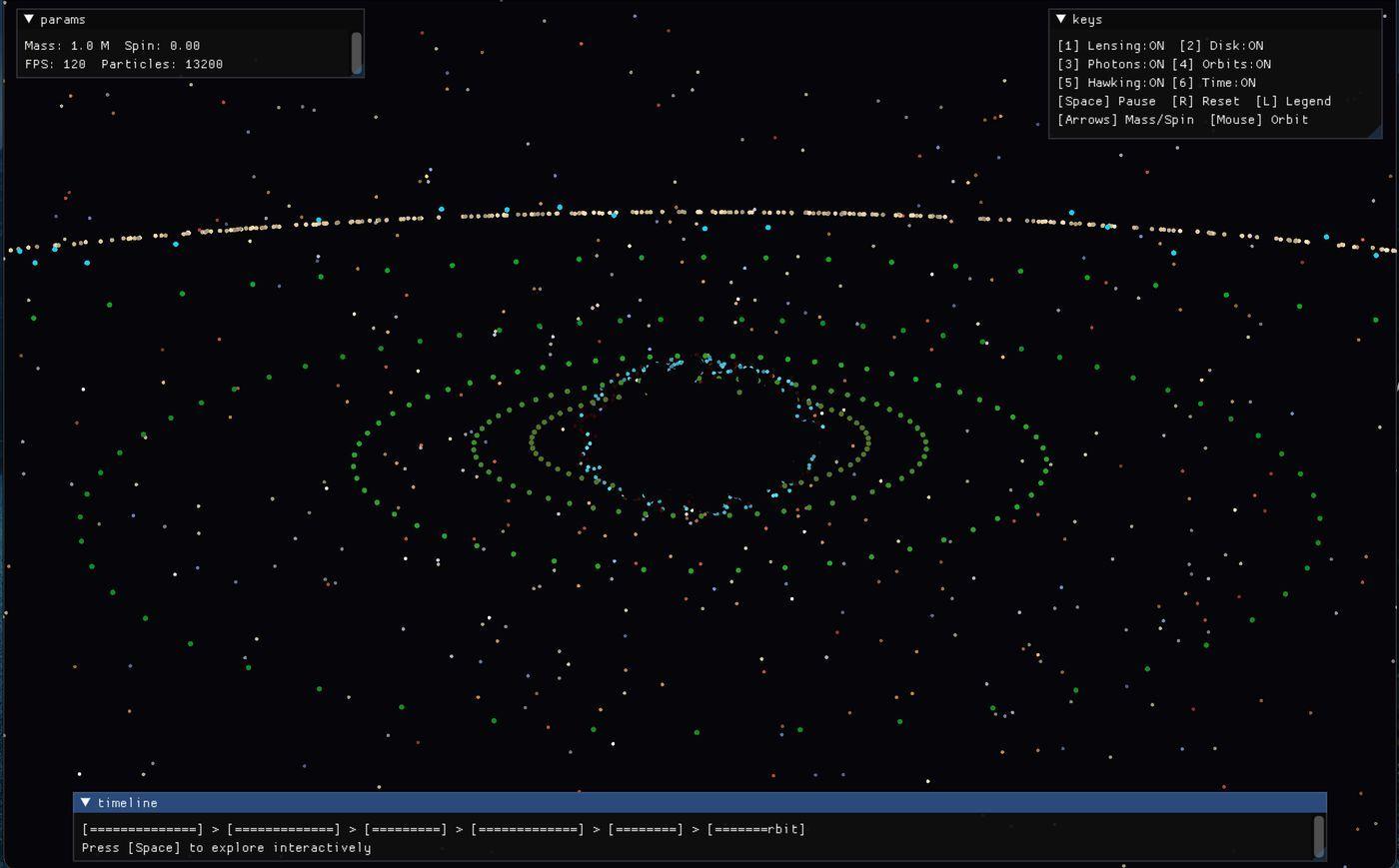
Drop a black hole into your laptop. This real-time simulation renders 13,200+ GPU-accelerated particles at 120 FPS, combining six gravitational phenomena into one cinematic visualisation. An 8,000-particle accretion disk spirals inward with temperature-driven colouring and relativistic Doppler shift — one side glows blue, the other burns red. Background starlight warps through gravitational lensing complete with Einstein ring magnification. Photons trace unstable orbits at the photon sphere. Hawking radiation spawns particle-antiparticle pairs right at the event horizon: cyan escapes, red gets devoured. Concentric rings pulse at rates set by Schwarzschild time dilation. Under the hood: a pseudo-Kerr potential with spin-dependent ISCO, symplectic leapfrog integration, and post-Newtonian lensing corrections. Toggle any of the six layers on or off, adjust mass and spin live, or sit back and watch the cinematic camera tour. Built in ~990 lines of Python and Taichi. Every pixel encodes a physical quantity — nothing is decorative.