Project Gargantua
An interactive GPU-accelerated simulation of how spacetime bends around a Schwarzschild black hole.
What it does
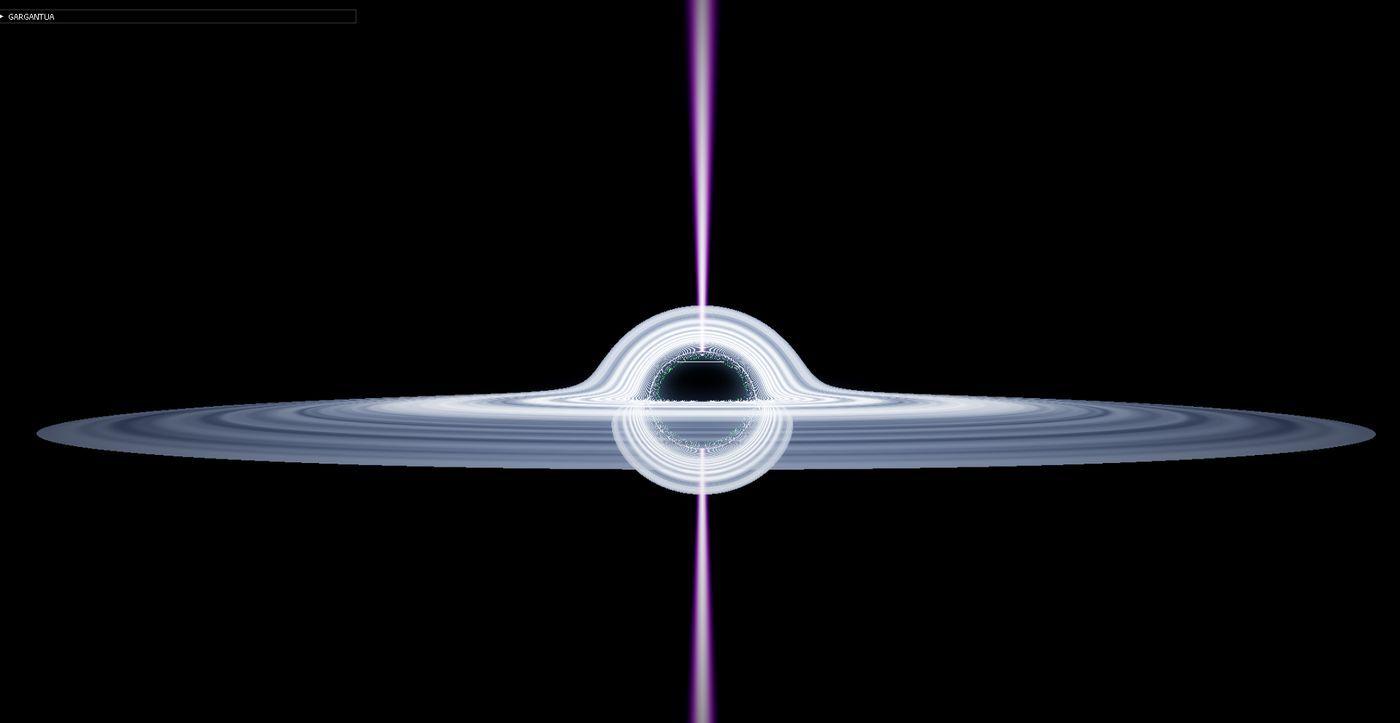
Project Gargantua is an interactive visualization of a Schwarzschild black hole built to make general relativity both beautiful and intuitive. Instead of treating a black hole as a simple sphere, the simulator models how extreme gravity curves spacetime, causing light rays to bend, accretion disks to distort, and the familiar black hole shadow to emerge naturally.
The simulation uses GPU-accelerated Taichi kernels together with physically motivated models for gravitational lensing, relativistic Doppler beaming, gravitational redshift, and a thin accretion disk based on the Novikov–Thorne model. A cinematic observer mode allows users to approach the event horizon and experience relativistic effects such as gravitational time dilation while exploring the system from multiple viewpoints.
My goal was not simply to create a visually impressive black hole, but to build an educational tool that demonstrates how Einstein's theory of general relativity produces many of the phenomena seen in modern astrophysics. Wherever practical, the visualization follows established physics, with approximations clearly documented where full numerical relativity would be beyond the scope of a real-time simulation.