Particle collider
An interactive 3D simulation that lets you tune beam energy, magnetic fields, and collision angles in real time to watch particle collisions unfold - and see the secondary particles they create - just like at the LHC.
What it does
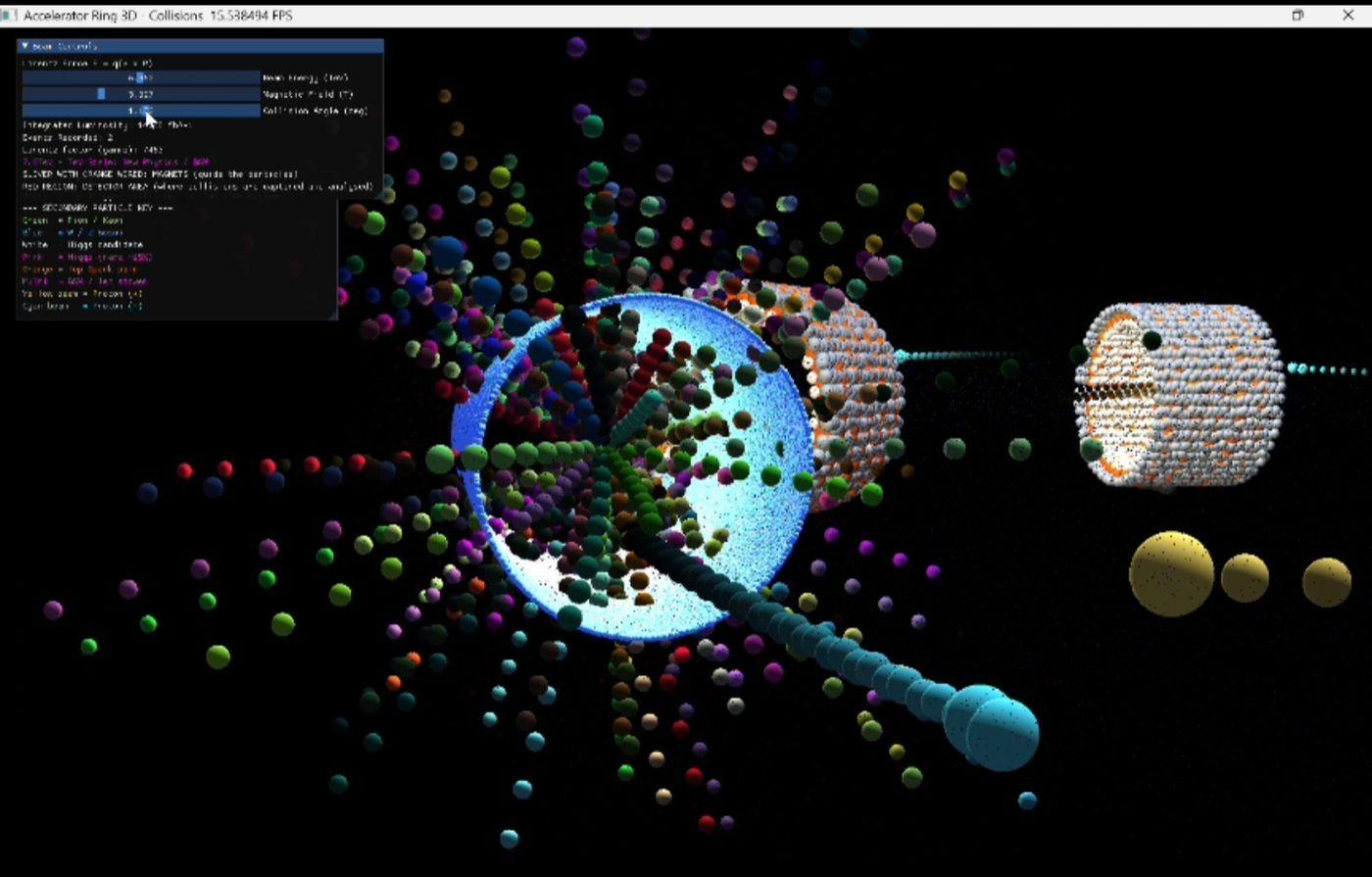
This project is a fully interactive 3D visualization of a particle accelerator, modeled on the working principles of the Large Hadron Collider. The camera can be freely controlled: left-click and drag rotates the view around the ring, while the UP and DOWN arrow keys zoom in and out, moving smoothly from a wide view of the full ring into a close-up of the detector region. At the top of the screen, live sliders let the user directly control three parameters: beam energy (0.1 to 14 TeV), magnetic field strength (0.1 to 10 T), and collision angle (-30° to 30°). Adjusting any of these instantly changes the particle behavior in the simulation - increasing beam energy speeds up the particles and shifts their energy regime label, increasing the magnetic field tightens their curvature, and the collision angle changes the geometry of how particle bunches meet. The particles travel around the ring, confined to a circular path by the Lorentz force, calculated from their velocity and the magnetic field. The silver structure wrapped in orange wire represents the magnets that generate this field, and on-screen labels identify this directly. The red region marks the detector area, where collisions are captured and analyzed. Once zoomed close enough into the detector (past 90% zoom), two manual controls become active: pressing C manually triggers a collision on demand, and pressing S switches into slow motion, letting the collision and secondary particle production play out frame by frame for a clearer view. If no collision is manually triggered, the simulation automatically fires one every 5 seconds inside the detector zone.When a collision happens, secondary particles are generated with colors tied to the beam energy at the time of collision: green for pions/kaons, blue for W/Z bosons, white for Higgs candidates, pink for a rare Higgs event (~15% chance), orange for top quark pairs, and multicolored for BSM (beyond Standard Model) jet showers. A live legend explains each color once zoomed in. The detector itself is simplified into a single visual layer, standing in for the real LHC's four-layer structure, to keep the visualization clear.