Hawking Radiation Lab: A Interactive Black Hole Evaporation Simulator
Explore Hawking radiation, black hole thermodynamics, and quantum tunneling through real-time scientific simulation and GPU-accelerated visualization.
What it does
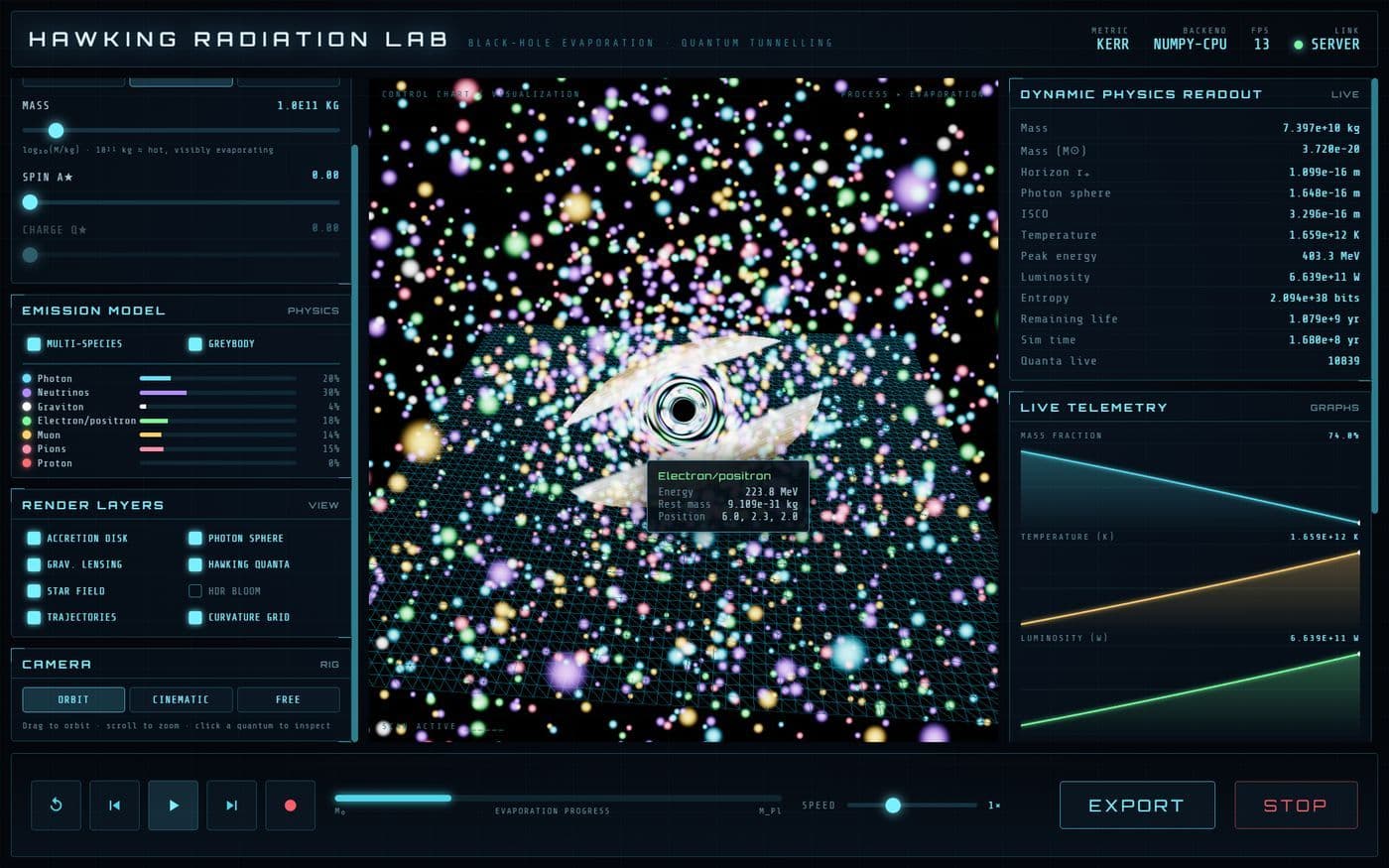
Hawking Radiation Lab is a research-oriented scientific visualization platform designed for students studying general relativity, quantum field theory in curved spacetime, and black hole thermodynamics. The application combines a validated Python-based physics engine with an interactive WebGL/Three.js visualization environment to simulate Hawking radiation and black hole evaporation in real time.
The platform supports Schwarzschild, Kerr, and Reissner–Nordström black holes, computing Hawking temperature, Bekenstein–Hawking entropy, horizon geometry, blackbody emission, greybody corrections, stochastic particle emission, adaptive numerical integration, and black hole lifetime estimation. Multiple particle species—including photons, neutrinos, electrons, positrons, and higher-energy particles—are emitted according to semiclassical physics.
A modern GPU-accelerated visualization engine renders event horizons, accretion disks, photon spheres, gravitational lensing effects, and Hawking radiation particle systems while providing interactive controls, live scientific plots, data export, parameter editing, comparison mode, and comprehensive educational annotations. The modular architecture, testing framework, and extensible plugin design make the project suitable for advanced education, research demonstrations, and future expansion into more complex relativistic simulations.