Gravitational waves
Visualizing the birth of gravitational waves through binary black hole mergers.
What it does
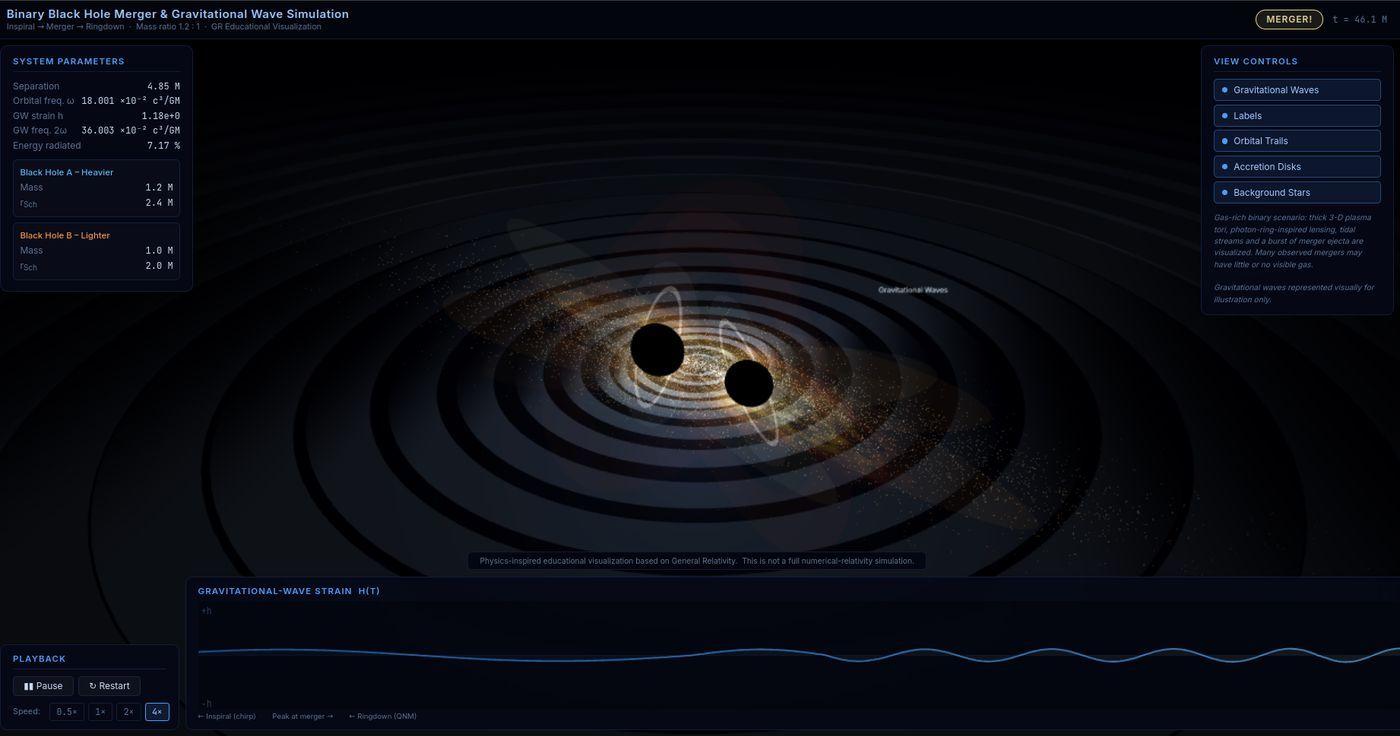
This simulation demonstrates the inspiral, merger, and ringdown of a binary black hole system and the resulting generation of gravitational waves. Two black holes with unequal masses orbit their common centre of mass while gradually losing orbital energy through gravitational-wave emission, causing their separation to decrease and their orbital frequency to increase. The simulation reproduces the characteristic gravitational-wave "chirp," where both the amplitude and frequency of the waveform increase until the moment of merger, followed by the damped ringdown of the final rotating (Kerr) black hole.
To enhance visual understanding, the simulation also depicts a hypothetical gas-rich environment surrounding the black holes. Three-dimensional plasma flows, photon-ring-inspired lensing, tidal streams, and merger ejecta are included as educational visualizations to illustrate how surrounding matter could be disturbed during a merger. These effects are not intended to represent every observed black hole merger, as many gravitational-wave events occur with little or no visible gas.
The project combines real-time 3D rendering with qualitative General Relativity concepts to create an interactive visualization that balances scientific accuracy with cinematic presentation, making complex astrophysical phenomena easier to understand.