Gargantua
A black hole with an accretion disk
What it does
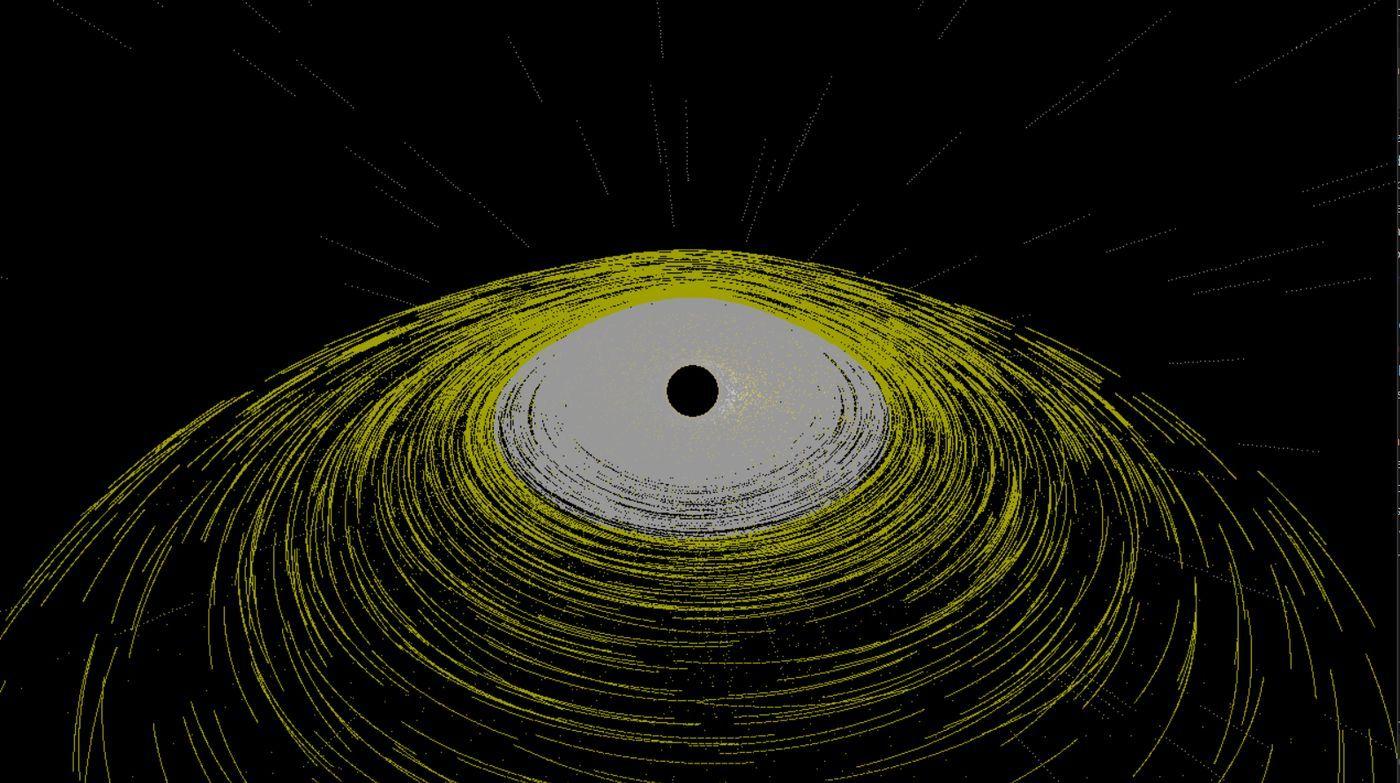
What makes this simulation extraordinary is that it isn't just a generic 3D animation—it's a mathematically rigorous, real-time physics engine rendering true general relativity.
Instead of faking the movement of the accretion disk, every single one of the 2,500 particles is independently integrated using a 4th-order Runge-Kutta solver to follow an exact equatorial geodesic through the curved space-time of a Schwarzschild metric.
The visual effects are equally grounded in astrophysics. The colors aren't arbitrary; they map directly to the Novikov-Thorne thermal profile, meaning the outer disk glows a cool, faint orange, while the Innermost Stable Circular Orbit (ISCO) burns a brilliant white-hot. As the particles whip around the black hole at relativistic speeds approaching $c$, the code calculates proper Doppler beaming, causing the side of the disk moving toward the camera to appear exponentially brighter than the receding side.
Most impressively, the optical warping isn't a post-processing trick. The GPU actively projects and bends the light from both the accretion disk and the background starfield using the exact Schwarzschild gravitational lens equations. This creates the geometrically perfect $5.196M$ circular shadow and the iconic "halo" effect as light from the far side of the disk is gravitationally dragged over the poles, all computed interactively in 3D space!