Black Hole Simulation
A Python simulation of a Black Hole.
What it does
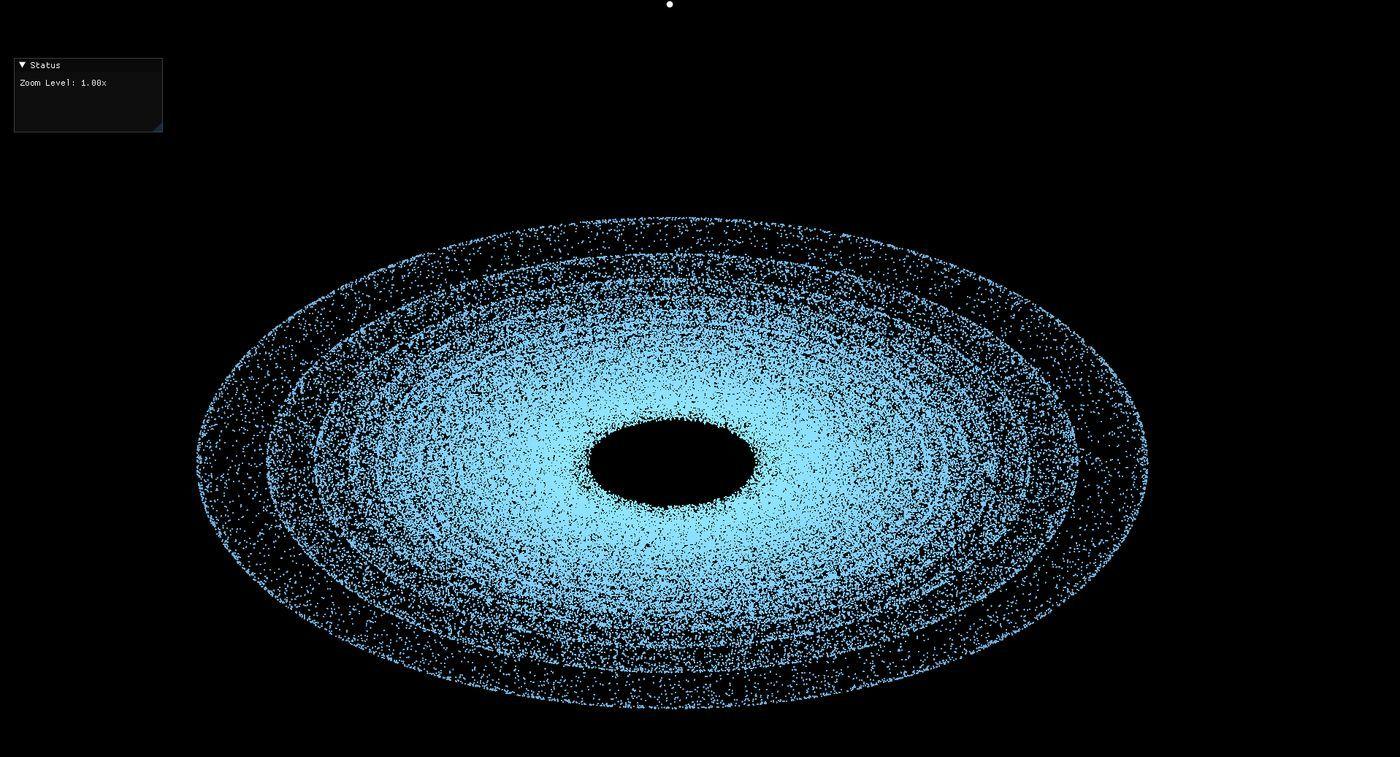
This simulation provides a high-fidelity, interactive visualization of a black hole’s accretion disk, governed by real-time particle physics. By utilizing a modified Newtonian gravitational potential, it captures the complex dynamics of matter as it approaches a central singularity. As particles orbit, they exhibit differential rotation—accelerating to extreme speeds near the event horizon—which is rendered with a physically motivated glow ranging from cool tones to intense blue-white. The simulation acts as both an observational tool and an interactive sandbox. Users can pan and zoom through the disk while manually exerting gravitational force to disrupt orbital resonances and observe the system’s reaction. The model effectively demonstrates phenomena such as orbital shearing and tidal interactions, turning raw gravitational equations into a visceral, cinematic experience. Designed for GPU acceleration, it maintains high particle density to ensure fluid, continuous motion. This project bridges the gap between abstract mathematics and visual art, offering a dynamic, immersive window into the extreme environment surrounding a black hole.