Binary Neutron Star Inspiral & Kilonova
A real-time GPU-accelerated simulation of binary neutron star orbital decay, relativistic gravitational lensing, synchrotron pulsar jets, and a kilonova merger shockwave.
What it does
This project is a high-performance, real-time astrophysical simulation built using Python and the Taichi high-performance GPU programming language. It models the final inspiral and explosive merger of a binary neutron star system—the exact cosmic event responsible for generating gravitational waves and forging the universe's heaviest elements, such as gold and platinum.
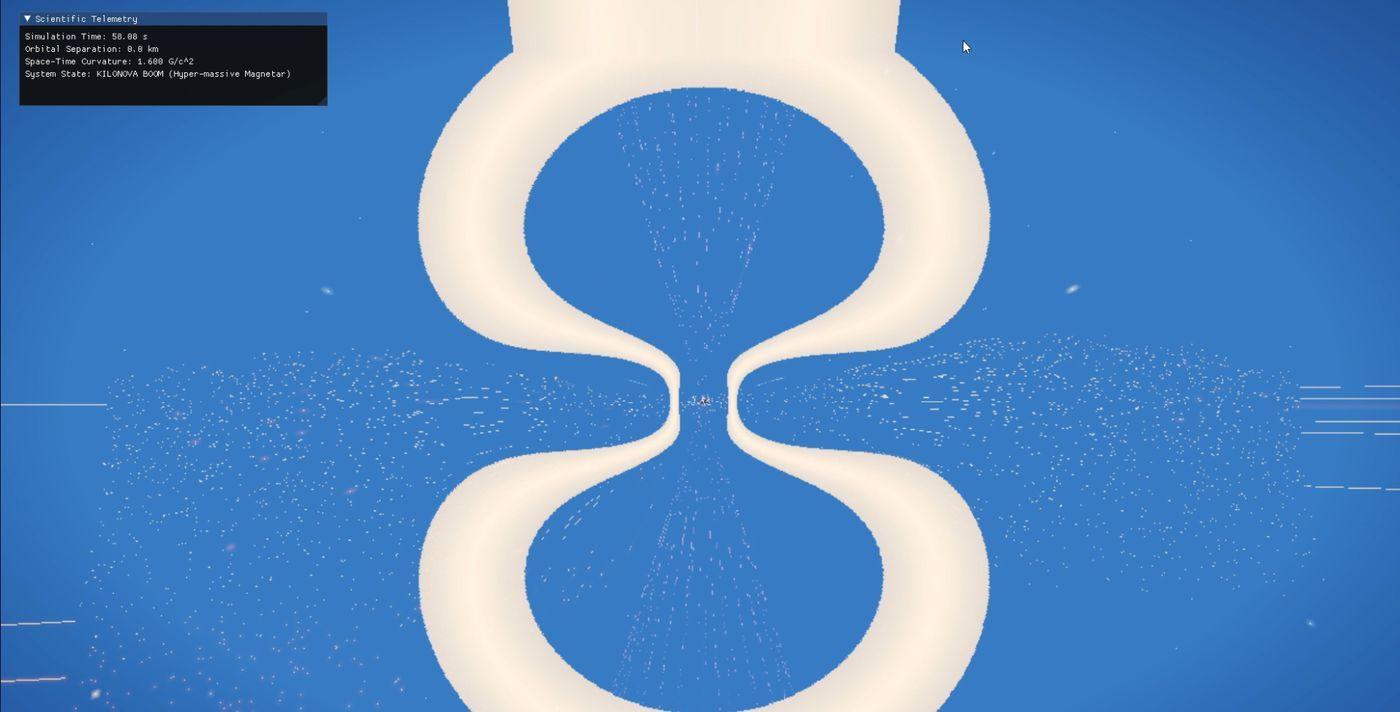
How it works: The simulation computes gravitational n-body orbital mechanics with inspiral damping to simulate orbital decay due to gravitational wave radiation. It features a Doppler-boosted plasma accretion disk where particle luminosity and frequency shift dynamically based on their velocity vector relative to the camera. Synchrotron pulsar jets sweep through space from the magnetic poles of the spinning neutron stars. Crucially, a custom post-processing shader calculates real-time relativistic gravitational lensing, physically bending and distorting the coordinates of background stars and accretion plasma around the gravity wells of the massive stellar cores.
Why it's cool: When the orbital separation reaches critical threshold, the system dynamically transitions into a "Kilonova" state. The binary stars collapse into a single hyper-massive magnetar, releasing a blinding gamma-ray overexposure flash and propagating a glowing, volumetric shockwave ring across the starfield. It bridges complex theoretical astrophysics with cinematic, real-time interactive rendering at 160+ FPS.