Binary Blackhole
A real-time, GPU-accelerated simulation of binary black hole coalescence and accretion disk dynamics
What it does
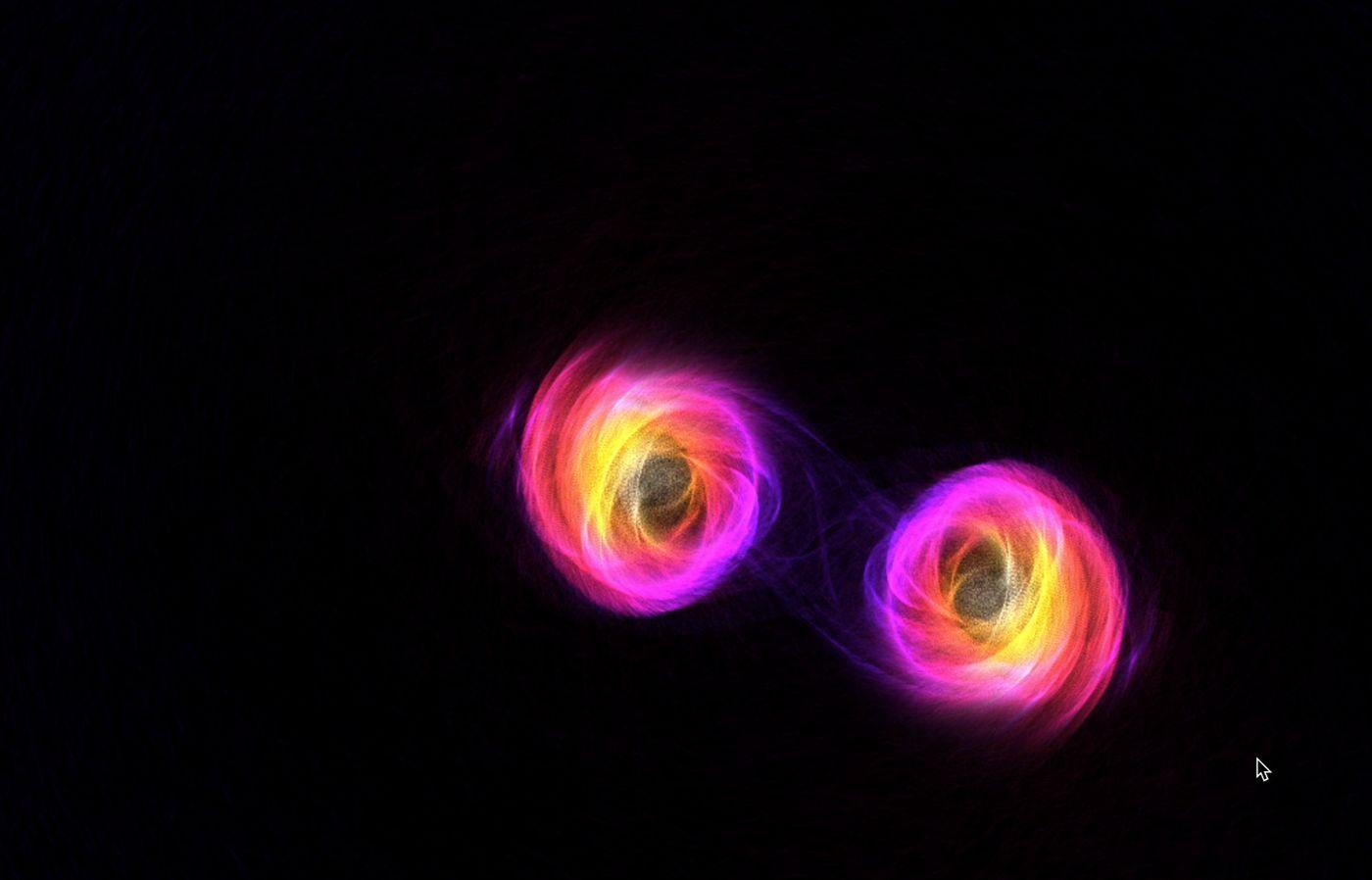
Binary Black Hole Dance is a high-performance, real-time physical simulation of a binary black hole system undergoing inspiral, coalescence, and remnant formation, surrounded by a dynamic accretion disk. Built using the Taichi Lang framework, the simulation executes fully parallelized on the GPU, enabling the simultaneous tracking and rendering of 850,000 accretion disk particles.
The orbital dynamics of the binary system incorporate first-order Post-Newtonian (1PN) corrections to model Schwarzschild-like precession (periastron advance), combined with a tangential drag force that mimics Peters (1964) gravitational wave energy and angular momentum loss. When the separation drops below the combined event horizon threshold, the black holes merge into a single remnant black hole. This process conserves linear momentum while converting 5% of the total system mass-energy into an expanding gravitational wave front.
The surrounding accretion disk consists of massless test particles executing chaotic orbits within the dynamic gravitational potential of the binary. Gas particles that cross the event horizon are absorbed, while escaped particles are recycled at the boundaries with Keplerian velocities. To visually capture the thermodynamics of the disk, particle speeds are translated to temperatures via the virial theorem and mapped to a thermal blackbody colormap. Relativistic visual features—such as the photon sphere (rendered as a glowing ring) and event horizon silhouettes—are fully integrated, offering a visually stunning, physically informed representation of binary black hole physics.